Monday, October 19, 2015

Bones! Bones! Bones!

Bones

In honor of the horrifying holiday of Halloween we have started
 learning all about the incredible skeleton system. Have you ever thought about what our bodies would be like without bones? 
Click here to watch an informative video on BrainpopJr about bones!


This diagram shows some of the most common bones in our bodies and their names. When you comment, please be sure to use the correct name and spelling for the bone you are discussing.


This is a great song to help learn all of the names of the bones in our bodies! 

  Creating skeletons, reading various non fiction books, and making our own diagrams has taught us a lot of important facts about bones. 

What is your favorite fact about our bones so far? In your opinion, which bone do you think is most important and why? Have you ever broken any bones?   


When you are done posting a comment practice naming the bones by playing this game. 

Name that Bone!

Monday, September 28, 2015

FABLES 


Over the last few weeks we have been exploring the world of folktales. This week we began reading various fables. Fables are a type of folktale that have the following elements. 


1. The characters in these short stories are usually animals. 

 The Tortoise and The Hare 


2. The animals will often have human characteristics, which is called personification


For example, The Fox and The Stork tell a story of a fox and a stork having dinner together and eating out of a plate.

3. Most importantly, fables have morals or lessons to be learned. 


We have been reading many fables that are claimed to have been told many years ago by a man named Aesop. 

Click here to watch a few Aesop's fables videos.


For this week's post, please comment on:


What is your favorite Aesop fable?  

What is the moral you learned? 

What fable gives you the best lesson for your life? 


------------------------------------- OR --------------------------------------

Who is Aesop? 

Use World Book Online Kids to read some interesting facts about Aesop and Ancient Greece. (login information can be found on the home page of my website)

Share what you learned with us! Remember you must write what you learned in your own words!


Tuesday, September 22, 2015

Cause and Effect


This week's comprehension skill is "Cause and Effect".

While reading it's good practice to ask yourself "why did this happen?" or "what is going to happen?"


Identifying the cause and effect can help you better understand the text or story!
Often sentences will have signal words that can help you identify the cause and effect.
Some words include:
so 
as a result
because
therefore
consequently
since 
 
Watch this BrainpopJr. for more on cause and effect!  


search: Cause and Effect 
username and password are on my website


Can you write a sentence and ask a friend to identify the cause and the effect. Remember our strategy! Break the sentence apart. 
When Hunter sneakily stole her tasty popcorn Mrs. Broussard began to cry . 

Ask yourself "What makes most sense?"

Hunter stole her popcorn BECAUSE Mrs. Broussard began to cry. 
or

Mrs. Broussard began to cry BECAUSE Hunter stole her popcorn.

Whichever part of the sentence follows the "because" can be identified as the cause! 
Whichever part precedes, or comes before the "because" is the effect!


Can you write a cause and effect comment? 
Identify which part of the sentence is the cause and which is the effect. 
Write another sentence and ask a friend to find the cause and effect. 
Challenge yourself by writing a sentence that does not use because as a signal word! 

Tuesday, September 15, 2015

Sensational Sentences 
In class we have been learning about the four different sentences and the punctuation marks that are used for each type.

 We used strong vocabulary to name our sentences. Today in class we made an educreations together to demonstrate our learning. Check it out.


We also talked about how great comments usually end with an interrogative sentence. This gives other bloggers an opportunity to respond back to you! 

Can you write a comment about your favorite type of sentence?  

Tell me why it's your favorite type of sentence. Provide an example. Be sure to use strong vocabulary when naming your sentence. Also use the correct punctuation marks!!! Try ending your comment with an interrogative sentence so someone can respond to you!

Tuesday, September 1, 2015

Delightful Dictionaries

What is the purpose of a dictionary? 


Both writers and readers use dictionaries as a wonderful resource. 

When readers come across a word they don't understand they can use a dictionary to: 

*find the definition or meaning of a word

*find examples of how to use the word

Writers can use the dictionary to help them:

*spell a word correctly

*use the correct part of speech or word form

*Find useful examples that can help them use the word in their own sentences! 

Dictionaries also have plenty of other interesting information! Look at the picture below. Some dictionaries include an interesting fact about each letter on the first page of its entries. 


Dictionaries also include diagrams, or labeled illustrations !

Illustrations are always labeled and sometimes even give history on where the word came from! 

For example, did you know that the word "aardvark" 

comes from Africa and means "earth - pig"? 


Aren't dictionaries intriguing! 

(ooh that's a high vocab word! Look it up in a dictionary to find out what it means!)


Now that we all agree on how fabulous dictionaries are, we need to learn how to use them! 

There are many parts to finding a word in the dictionary. Use ABC order and the guide words. 

Guide words tell you what the first and last word on the page is. So you need to use your brain to figure out if your word falls in between the guide words. 

 The guide words here are foghorn and food chain. Is the word fork on this page? 


Here are some Educreations made by some students on our didactic dictionaries. 


What are some new and intriguing words you can find in the dictionary? In your comment, tell us what word is, its most common part of speech (noun, verb, adjective) and its definition!

Wednesday, August 26, 2015

What do responsible students do?

This week we talked a lot about the responsibilities of being a third grader in Room 9. In order to create a class pledge and determine our classroom rules we answered 4 important questions.

First, we shared why we thought school was important. Most of us said that school is important because it helps us learn.


I wanted to know why learning was so important. As a class we decided that learning helps us prepare for college or jobs, so we can have a good future. It teaches us how to make good friends, and discover our own talents. Most importantly it makes our lives and the world better!

Next, I asked Room 9 to tell me what they hope to learn this year. After categorizing our answers we found 5 major themes. 


1. Math - multiplication and division

2. Technology including blogging

3. How to become better writer's including writing in cursive

4. Science and history

5. How to improve our reading skills. 

Since we all agreed that school is important and listed all of the things we are eager to learn, we needed to come up with some specific behaviors that will help us reach our goals. 

We sorted our answers into categories and found that listening and being respectful were the most important. We also talked about our attitude toward our learning and our responsibilities as students. Once we put all of our ideas together we created our classroom pledge!


A few ways to show you are a responsible student is by the way you act on the carpet. Brutus and Tank helped me demonstrate some key behaviors. 

 Always raise your hand before speaking!

Stay in one place and don't distract other learners!


Keep your focus on your learning!


In your opinion, what is the most important thing you can do to be a responsible student? 


What are your personal strengths as a student and what do you think you need to work on?  


Monday, June 1, 2015

Wildlife Experience Visit


Wildlife Experience Visit

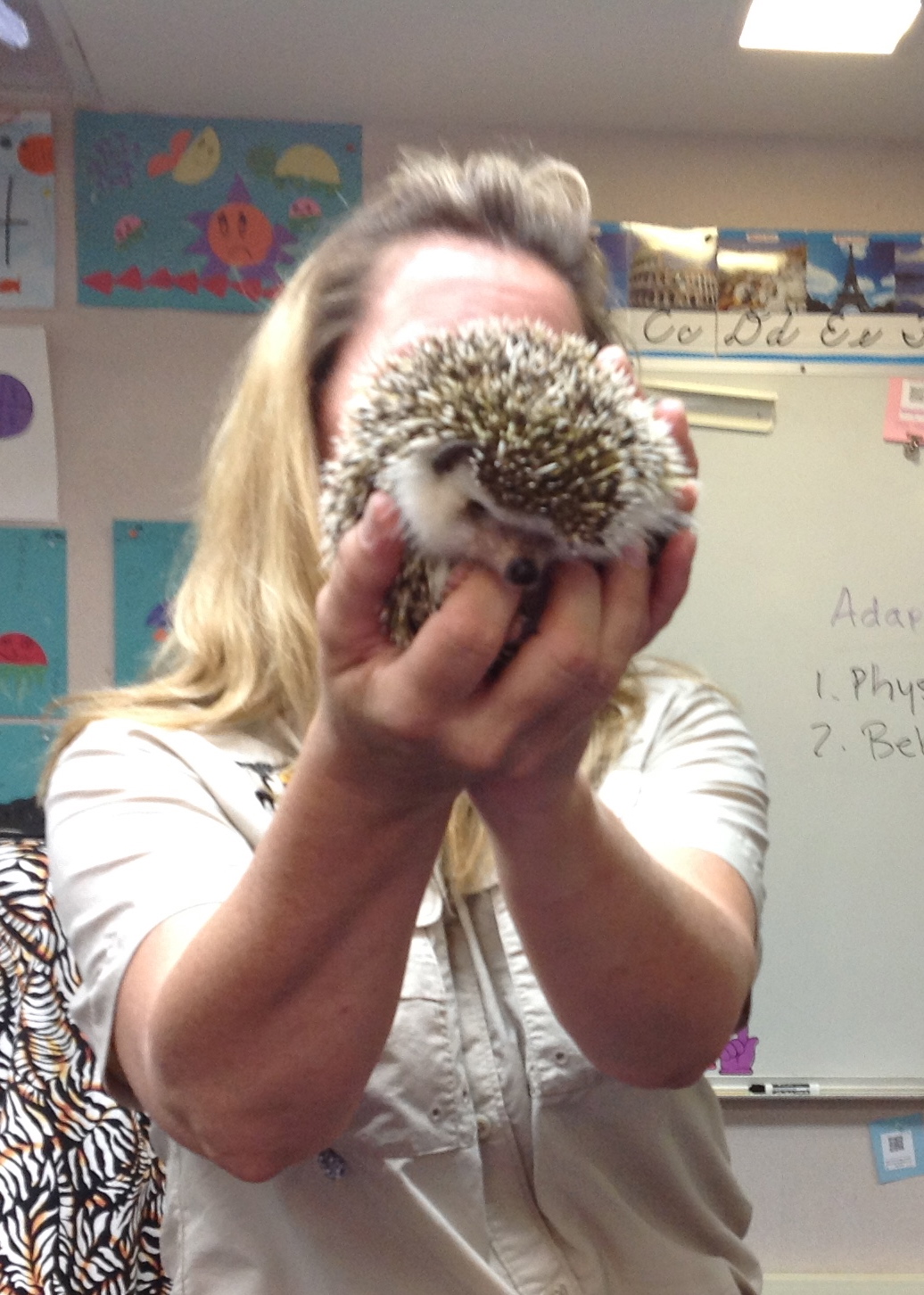
Its body is covered in short yet sharp quills and is often mistaken for a larger rodent that has larger quills. This animal can be found in the dry savannahs of Africa. Can you guess what animal came to our classroom today? 

A hedgehog! 


It may be difficult to identify this little hedgehog, since he is almost completely curled up into a ball.  
This hedgehog, Tucker, uses his quills to protect himself in his habitat. However, the way in which he uses his quills are part of some of his behavioral adaptation. 
Isn't he adorably adorable?

But that's not all. We also had the opportunity to meet a local bird. This bird is even part of Calabasas' city symbol. 

You have most certainly seen the red tail hawk soaring above you. The Wildlife Experience rescued this bird from Northern California and has had her for about 15 years!


We learned many interesting facts about both animals as well as many other birds. 

Please write a comment about either animal that is a least 3 sentences long. Choose a behavioral or physical adaptation you thought was most interesting and tell your classmates how this adaptation helps it survive! 
You must have at least 2 compound sentences. 

I wonder what animals we will see tomorrow!